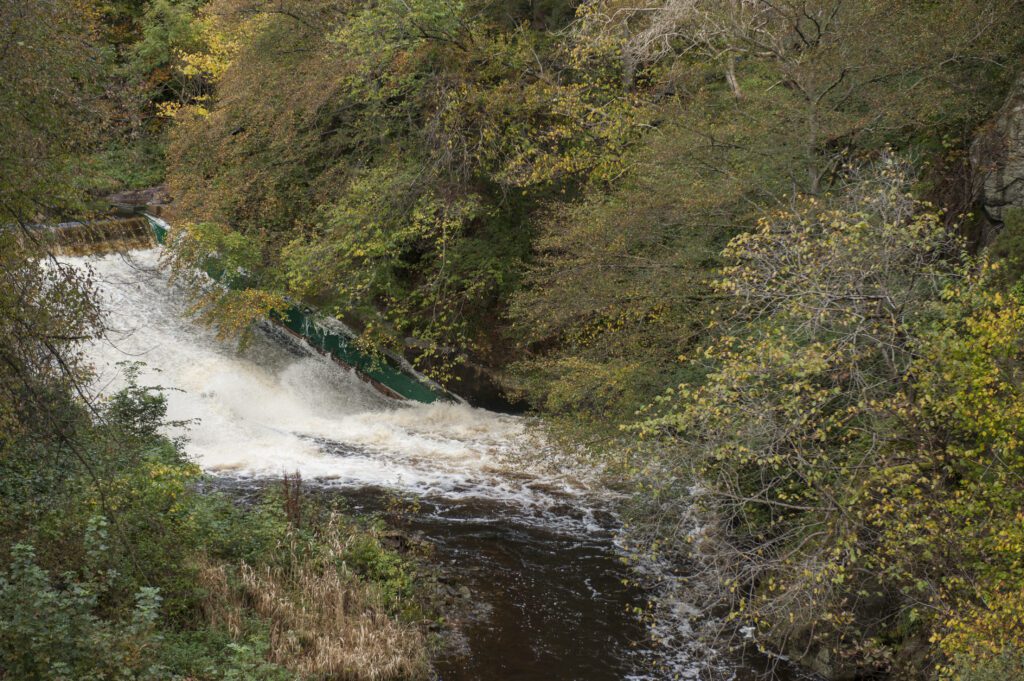
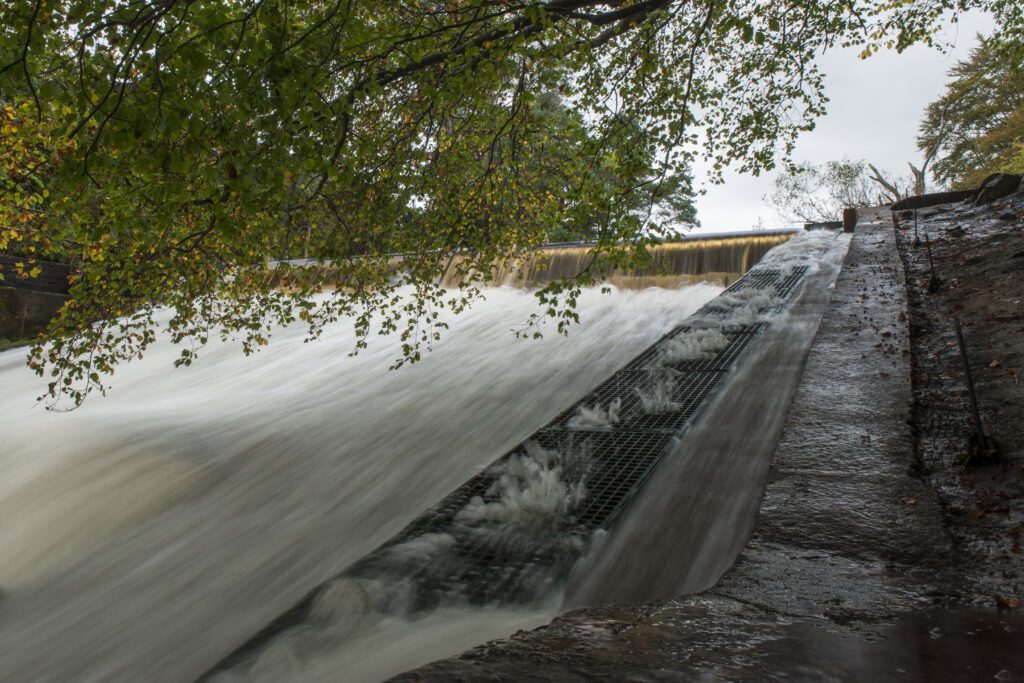
The Culter burn is the second largest tributary of the Dee, its network of 121km of streams enter the Dee at Peterculter. However, for 250 years, nearly all (119km) of the catchment’s streams has been out-of-bounds to migrating salmon and sea trout due to a huge dam, originally created to supply water to a papermill.
In 2014, the Trust and Fishery Board installed a fish pass on the Culter dam. A ‘denil pass’ design, it enables fish to swim up the dam, ascending 5 metres, by creating a tunnel of slow-moving water. The fish pass was installed with the support of local businessmen Martin Gilbert and Stewart Spence and allowed salmon access to the Culter catchment for the first time in 250 years.
In that first year of 2014, 38 salmon migrated up the fish pass into the Culter Burn. The following 3 years, at a time of low overall stock numbers, saw lower numbers of salmon enter the Culter (between 9 and 15 fish). In 2018, 27 salmon migrated upstream.
Electrofishing surveys have revealed some very healthy offspring of these adult fish returning to the Culter catchment. 1-year-old ‘parr’ in the Culter were up to 127mm long – in the upper catchment this is the size of a 2- or 3-year-old fish! It suggests the Culter catchment is providing the fish with excellent opportunities for strong growth. Big parr means big smolts and a higher chance of surviving their ocean migration to return as adults.
There is still one obstacle remaining on the Culter catchment – the Garlogie dam, which is the biggest remaining obstruction in the Dee. We’ve estimated that 30% of the suitable fish habitat on the Culter lies upstream of it. The good news is that, thanks to funding from SEPA’s Water Environment Fund, the Garlogie dam will be removed in 2022/23, allowing fish free access to the full catchment.